+60
Companies using the all-in-one solution
+84%
Tasks executed through the platform
+49%
Active users on platform
+28%
Revenue increase
I led discovery, solution design, and delivery of Doinn's all-in-one platform. Over four years I worked across the full product: user research, ethnographic observation, flow mapping, and interaction design.
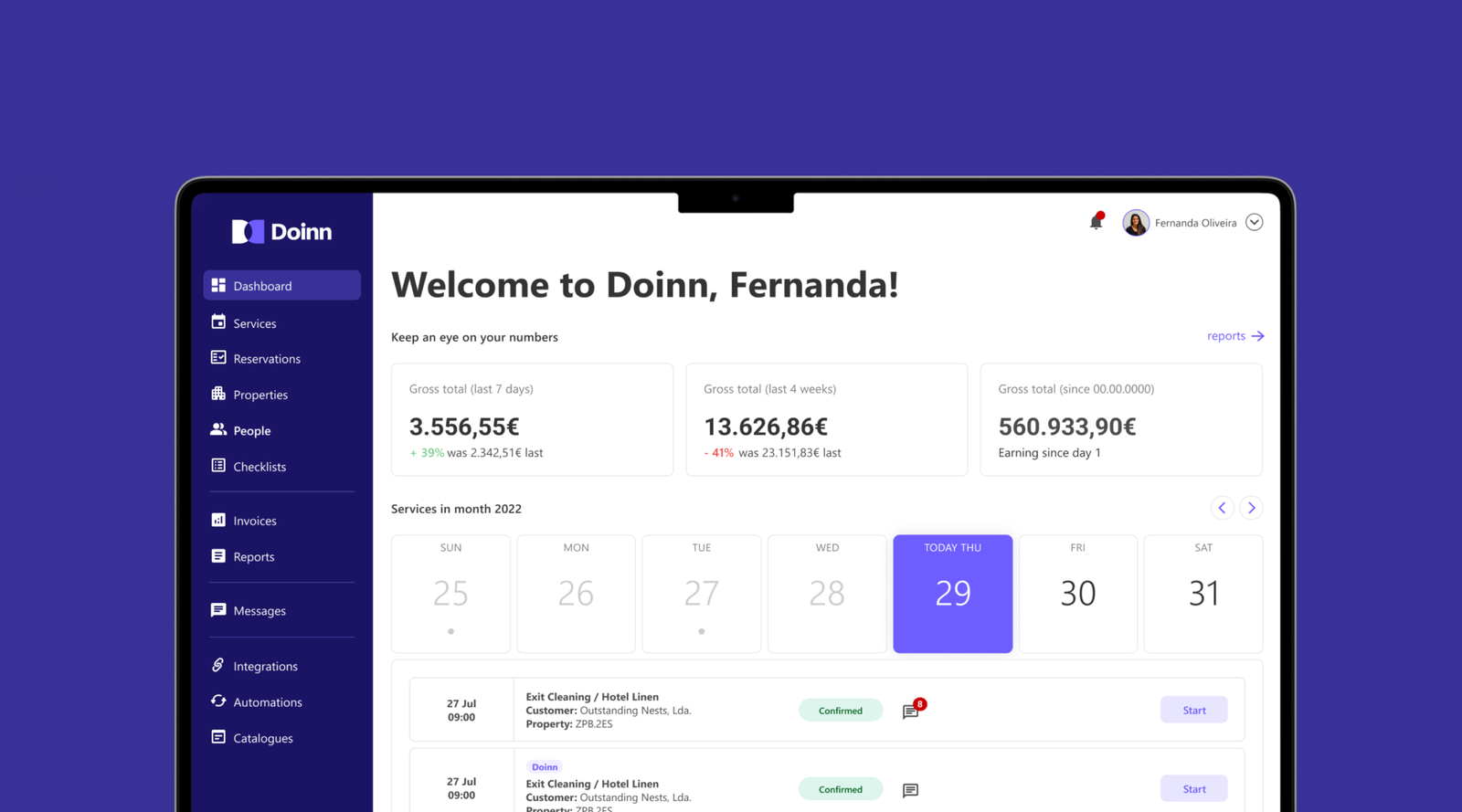
An all-in-one platform where property managers and cleaning companies can bring their customers, properties, and jobs into one place to schedule, automate, and stay in sync with their teams.
Coordination without infrastructure has a cost
Property managers and cleaning companies were running their entire operations through WhatsApp groups and Excel spreadsheets, coordinating hundreds of jobs per day with no shared visibility and no single record. When things went wrong, the cost wasn't an inconvenience: a bad guest review, a compensation claim, a lost contract.
What we found when we stopped asking and started watching
Rather than running interviews from a distance, I got added to the actual WhatsApp groups cleaning companies use to manage their operations. The goal was to watch, not to ask: how jobs get assigned, how issues surface, how information disappears into scroll. Weeks in those groups surfaced things no interview guide would have caught.

Critical information has no permanent home
Door codes, special instructions, and last-minute changes live three scrolls down in a thread, buried under photos of damaged linen. When teams need it, it's already gone.
Two user types, opposite pain points
Paul (property manager, ~100 properties) has zero real-time visibility. Ana (cleaning company manager, ~50 properties) is overwhelmed by coordination friction and human error. The same operational gap, two very different jobs to be done.
Spreadsheets as "source of truth" — always out of date
They use Excel for scheduling but update it manually. It's never synced and almost never reflects what's actually happening on the ground.
End-of-job confirmation is a manual ritual
Ana's team sends a WhatsApp message confirming job completion to every property manager, every time. Dozens per day, all of it automatable.
Trust is the real product
Both user types share the same underlying need: confidence that the job was done correctly, on time, no surprises. The platform's job is to make that automatic, without anyone picking up a phone.
Structured interviews to validate what observation suggested, and answer what it couldn't
Watching the WhatsApp groups told me what was breaking. It didn't tell me why it kept breaking, or whether the pattern held outside the specific teams I'd been added to. I ran structured interviews with property managers and cleaning company owners, walking through their day minute by minute: how they open the morning, how a job gets assigned, what happens when something goes wrong, how a day closes. The goal was to pressure-test the assumptions before designing around them.
The day's priorities live only in someone's head
Neither Paul nor Ana worked from a written plan. Prioritization was a mental model built from memory and gut feel, which meant it couldn't be inherited, delegated, or built into a product without first making it explicit.
"One workflow" was the wrong assumption
Property managers and cleaning companies organize their days around different questions. Paul's starts with "what needs to happen today." Ana's starts with "who's available to do it." A single shared workflow would fail one side, no matter which side you designed it around.
Trust erodes slowly, not all at once
No single missed job ended a relationship. What did was the accumulation of small, unexplained gaps: a job marked done with no proof, a question that went unanswered for a day. Trust turned out to be a pattern of small signals, not one big failure.
Contracts and pricing live entirely outside any tool
Terms were negotiated over calls and paper, then never touched again inside whatever system either side used. Nobody had built for this part of the relationship, us included.
Property managers and cleaning companies ran their entire operations through WhatsApp groups and Excel spreadsheets. Hundreds of jobs a day, no shared record, no fallback when things went wrong.
Four companies, one continuous feedback loop, before anything opened to the wider market
Before opening the platform beyond the pilot, I invited four companies (two property managers, two cleaning companies) to run their actual operations inside the beta, with a direct feedback channel open throughout. Not scripted tasks: real jobs, real staff, real messages. The friction that surfaced was the friction that would show up at scale.
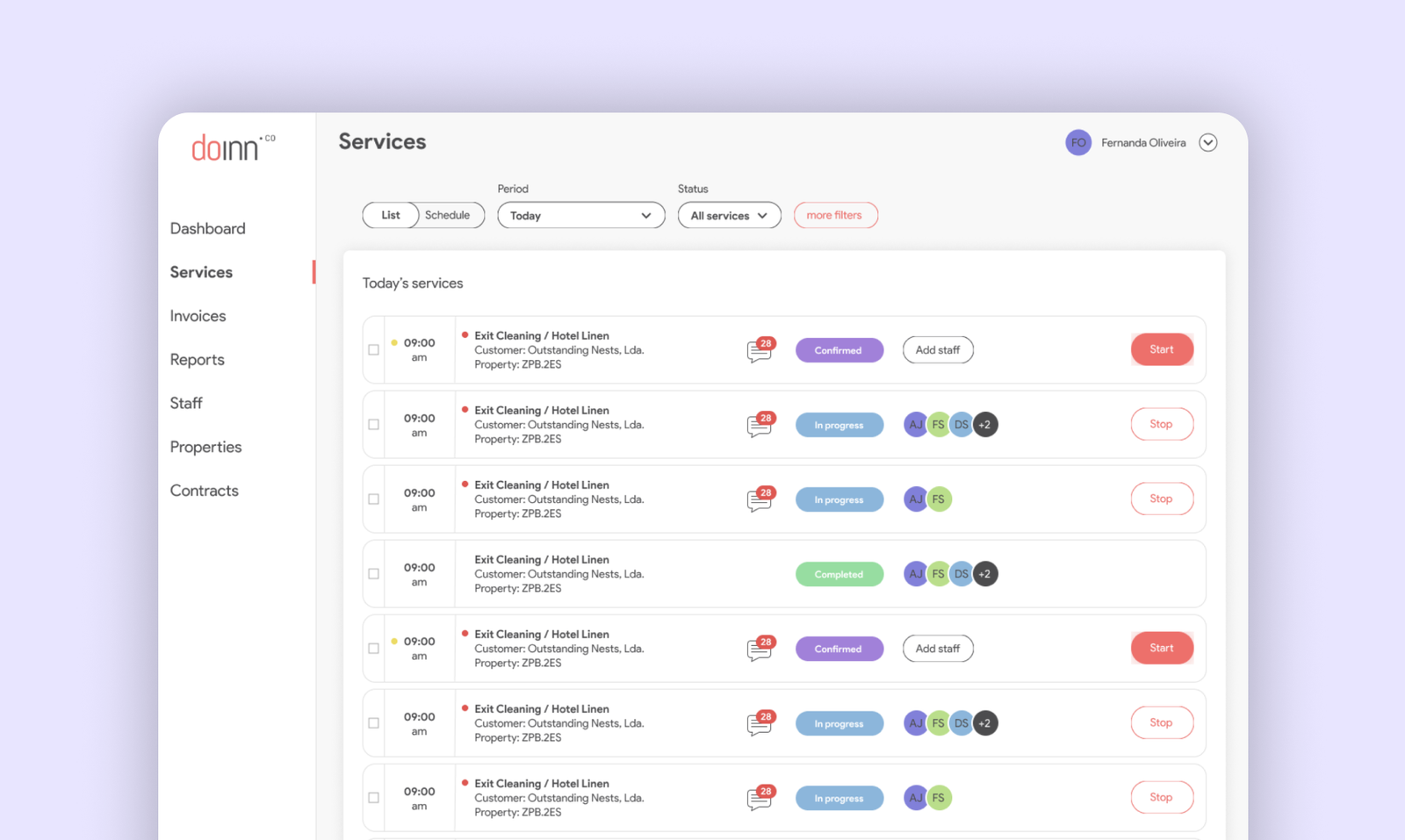
Running real operations through the beta, not just testing it, surfaced friction that a lower-fidelity validation pass wouldn't have caught. Every one of these changes shipped before the platform opened beyond the pilot group.
A two-sided operations platform that replaces coordination by group chat
The final product ships as one platform with two role-aware experiences. Property managers and cleaning companies share the same job record, but each side sees only what's relevant to their role. No calls to confirm what happened. No messages when a job closes. No manual checking on whether the team arrived.
For property managers
A real-time view of every property, every job, and every cleaning team, with no WhatsApp messages required. Status updates automatically. Photo evidence arrives at close. Issues come with context, not just a notification.
For cleaning companies
A daily view built around how cleaning operations actually run: by staff, by property cluster, by time. Job templates cut repetitive setup. Bulk onboarding handles seasonal spikes. Completion is a tap, not a message thread.


+60
Companies using the all-in-one solution
+84%
Tasks executed through the platform
+49%
Active users on platform
+28%
Revenue increase
The value proof happens outside the product.
The platform serves operators well, but the final proof (a clean, on-time handover) is invisible inside it. Where multiple parties are involved, you need an external signal to know how things actually landed. Even lightweight guest feedback would give operators performance data no internal task log can match.
Field constraints surface late when you start desktop-first.
Ethnographic research showed cleaning teams reaching for their phones mid-job, but the initial design was desktop-first. That mismatch showed up later than it should have. Context of use should set the starting point.